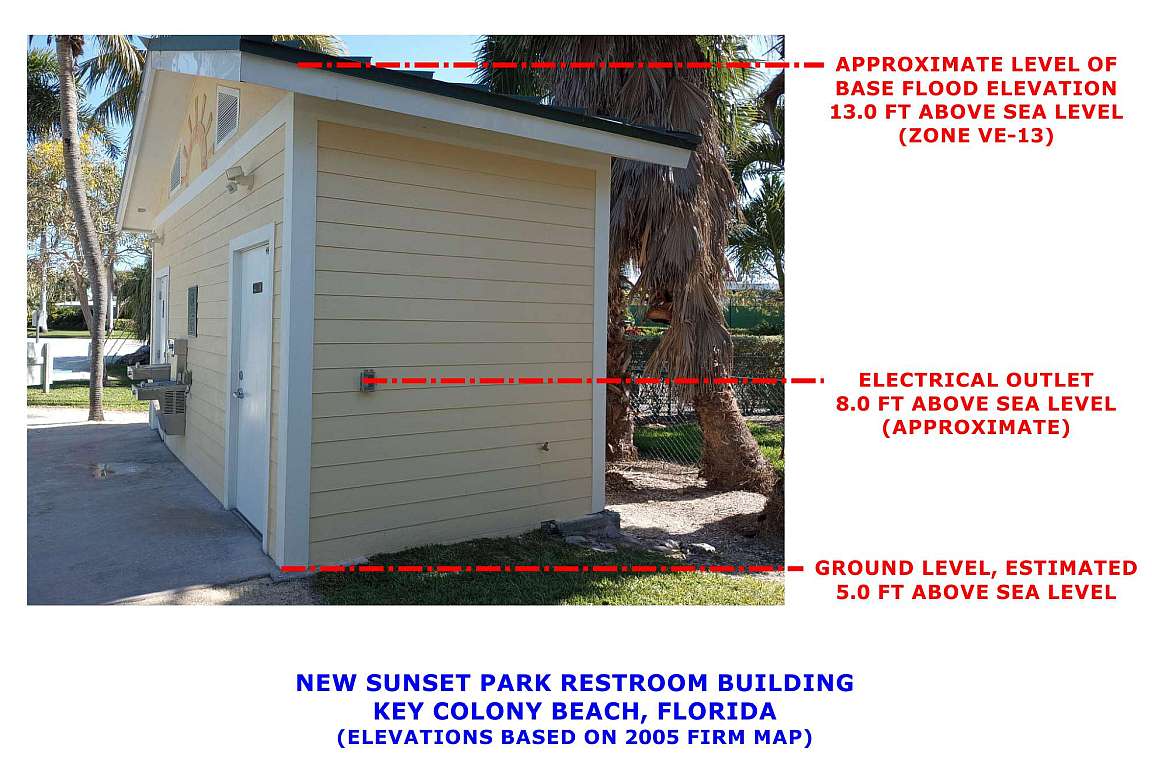
People are asking, Why don't the Sunset Park restrooms meet flood rules?
Due Diligence ... » The Building Official said, "The bathroom doesn't have to be raised above base elevation."
» The official is mistaken.
» Flooding is a way of life in the Florida Keys.
In flood hazard areas, including coastal high hazard areas (Zone V), public restrooms, like other non-residential structures, must be built above the base flood elevation (BFE) or dry floodproofed.
» The FEMA Flood Zone Map defines "A" Zones (A, AH, AO, and AE) and "V" Zones (V and VE) as "High Risk, Special Flood Zones."
» The FEMA Flood Zone Map shows that Sunset Park is in Flood Zone VE-13. That means the height (elevation) of the main floor must be at least 14.0 feet above sea level.
» The Florida Building Commission notes that the NFIP has for nearly 50 years considered public restrooms as non-residential structures that must be constructed above the base flood elevation in special flood hazard areas including Zone V.
FEMA Technical Bulletin 5 dated March, 2020 For Buildings Located in Coastal High Hazard Areas in Accordance with the National Flood Insurance Program
6.5 Mechanical, Electrical, and Plumbing Equipment, Ducts, Tanks, and Fixtures
Mechanical, electrical, and plumbing equipment, ducts, tanks, and fixtures serving elevated buildings are required to be elevated to or above the BFE or protected from water entry during the base flood.
7.8 Restroom Buildings and Comfort Stations
Restroom buildings and comfort stations must be treated the same as other types of structures in Zone V and must meet the same elevation and design requirements as other buildings even when the facilities are situated in public parks or recreation areas.
» Florida Building Commission further notes that communities are reluctant to [build] public restrooms at or above grade, but below BFE ... if the federal program finds such structures non-compliant because they are "below the BFE."
» As the photograph shows, KCB constructed the Sunset Park restrooms below BFE with no provision for storm surge or flood waters. There are no flood vents in the walls. The plumbing and fixtures are not protected from salt water intrusion. The electrical outlets are below BFE.
In Florida, public restrooms in coastal high hazard areas (Zone V) and coastal A zones must be elevated above the base flood elevation (BFE), or dry floodproofed, to comply with National Flood Insurance Program (NFIP) regulations.
Here's a more detailed explanation:
NFIP Requirements:
The NFIP considers public restrooms as non-residential structures that must be constructed above the BFE in coastal high hazard areas (Zone V).
Coastal High Hazard Areas (Zone V):
In these areas, public restrooms must be elevated on pilings or columns with the bottom of the lowest horizontal structural member of the lowest floor elevated one foot or more above the BFE.
Exceptions:
While restrooms are generally not permitted below the BFE, there are some exceptions for minimum necessary electric equipment and plumbing fixtures and connections, if designed and installed to minimize or eliminate infiltration of floodwaters.
Florida Building Code:
The Florida Building Code reflects these NFIP requirements, mandating that public restrooms in flood hazard areas are designed and constructed to minimize flood damage. In Florida, this has resulted in building public use restrooms as high as 7 to 18 feet above grade.
People Are Asking why KCB doesn't have to meet flood rules?